
Close out 2026 by Teeing Up 2027 for Success
Do you have a claim? Have you reported your yields? And what does it all mean for 2027?
Harvest is winding down, the combines are getting parked, fall fieldwork is well underway and most of us are starting to think about next year's crop.
But before we put 2026 completely behind us, there are a few crop insurance items worth addressing.
We all spend considerable time developing a plan to grow the crop. Let's make sure we finish the year with a plan to protect it, too.
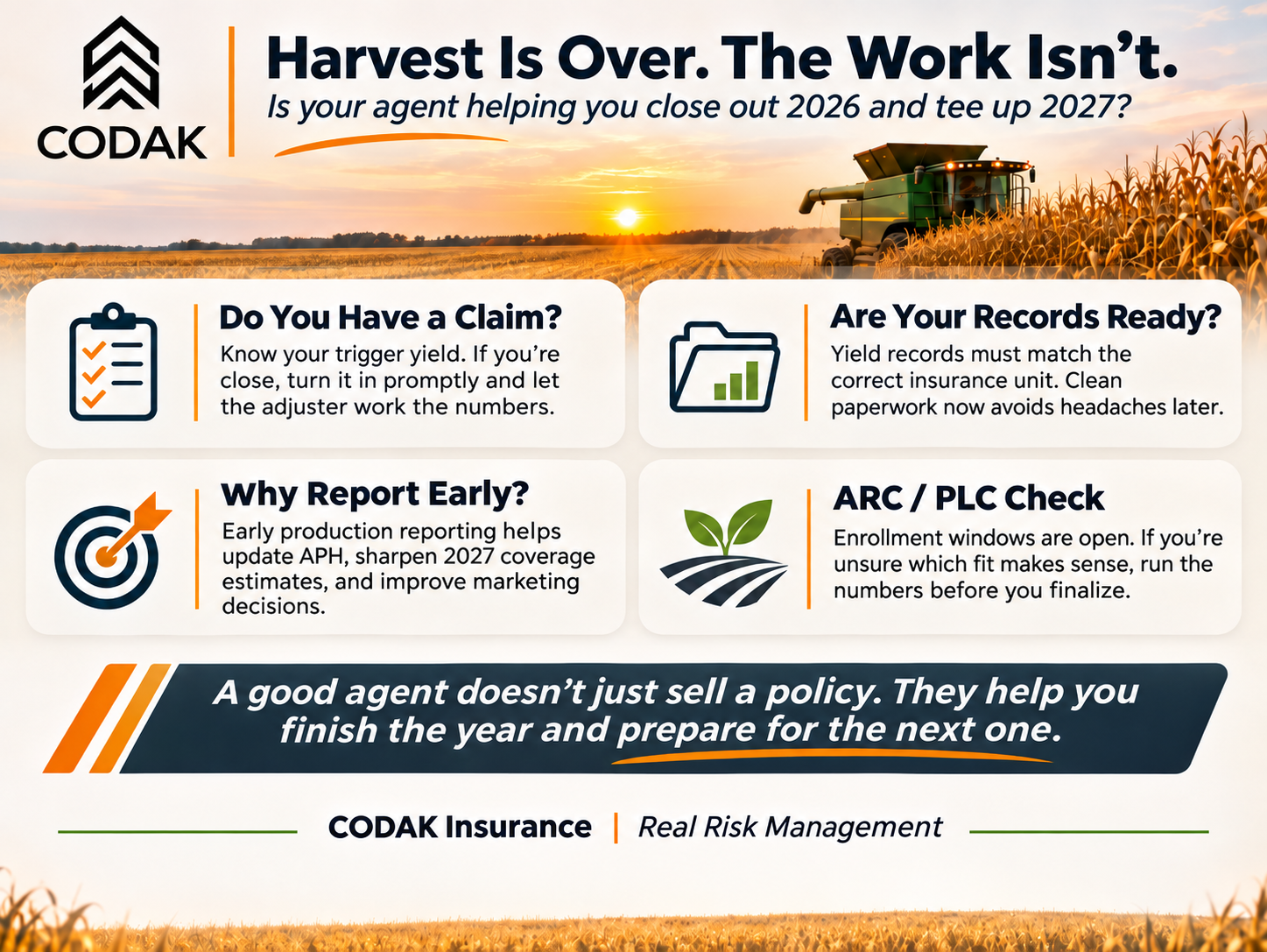
1. Do You Have a Claim?
The 2026 harvest prices are finalized at $4.75 for corn and $12.63 for soybeans, both higher than their respective spring projected prices.
That means your trigger yields are higher than what you initially calculated with initial spring prices. Your crop insurance agent should have notified you of your triggers the first week of November. If not, you need to get them ASAP.
What yield triggers a claim on your farm? Does it change between fields? Do you have Optional, Basic, or Enterprise Units?
These aren't trivial distinctions.
For example, a 230-bushel approved corn yield insured at 85% gives you a 195.5-bushel production guarantee under standard Revenue Protection. But whether one field's poor performance triggers a claim depends on how your insured units are structured.
If you need help, call us.
And remember, reporting a potential loss is your responsibility.
Generally, you must notify your insurance company within 72 hours of discovering damage for a production loss, but no later than 15 days after the end of the insurance period. Revenue Protection also has a separate notice provision for revenue losses without production damage.
Regardless, sooner is better!
One more thing: crop insurance isn't like homeowners insurance. Filing a claim notice does not automatically increase your premium because of claim frequency.
If you're close to a claim, report the potential loss promptly and let the adjuster work through the numbers. Don't wait until every bushel is hauled to town.
2. If You Have a Claim, Have You Turned It In?
Maybe you reported your loss weeks ago. Great. Now what's the timetable for getting it finished?
Has the company adjuster contacted you? Do you have their phone number and email address? What information is still needed to settle the claim?
In most situations, we're talking about two things: finishing harvest and providing acceptable production records.
Make sure those records match the appropriate crop insurance unit.
Your field names, FSA farm numbers, and insurance units don't necessarily line up. One insurance unit might contain multiple farms or fields, and the unit structure may be different than last year.
On my farm, we have 555 acres with four legal owners, two FSA farm numbers (seven tracts), and two different crop plans split east and west. Yet, for the insured crop, it's all reported under one crop insurance unit.
That's why understanding your unit structure matters. Your agent should have walked you through it when setting up your coverage.
A truck scale ticket or yield monitor total doesn't do much good if we can't determine which insured acres produced those bushels.
Accurate, organized production records can make the difference between a straightforward claim and a long process chasing paperwork.
3. Don't Have a Claim? Why Haven't You Reported Your Yields?
If harvest is complete, you already have a pretty good idea what your final production was. So why wait until April to send it to your agent?
Yes, there may be differences in shrink, moisture adjustments, or final bushels when you empty your bins this winter. That's understandable.
Did you know that you can have your crop insurance company measure your bins? Not all of us have scales.
For standard corn and soybean policies in most of CODAK’s client areas, April 29, 2027, is the production reporting deadline. You can amend an early production report before that deadline with properly supported numbers.
But please, be accurate.
During an Actual Production History (APH) review, RMA generally allows a 5% tolerance for overreported yields. More specifically, its rounding rules place 5.49% within tolerance and 5.50% outside it.
That is NOT a target to shoot for!
Overreporting beyond the tolerance can result in an assigned yield. Under standard APH provisions, that assigned annual yield generally cannot exceed 75% of the previous year's approved yield.
If you had an approved yield of 200bpa last year, then an assigned yield would be 150bpa.
Ouch.
It's particularly important to get lower yields right. A one-bushel mistake on 50-bushel soybeans represents a 2% error, while that same one-bushel error on 230-bushel corn represents less than half of 1%.
The lower the yield, the less room you have for error.
4. Why Turn in Production Early?
Now we're getting to what I think is the most overlooked opportunity.
We all have bankers. Many of us carry operating debt. We'll be meeting with lenders, landlords, and vendors this winter as the annual "meeting season" begins.
What if you had your updated 2027 APH numbers and a realistic marketing plan in hand before those meetings?
If you submit your 2026 production now, along with your anticipated 2027 crop plan, your agent can begin building a much more accurate picture of your upcoming coverage.
We can estimate your approved yields, model your production guarantees, and begin calculating what portion of next year's crop you can confidently forward market.
Those numbers aren't completely final yet. Spring projected prices, coverage elections, approved APH adjustments, and other policy details still matter.
But think about the decisions we can start making:
How much production can we reasonably expect?
What portion of that production do we have protected?
How many bushels can we consider selling ahead?
And how do those sales line up with the expenses we'll need to pay?
At CODAK, we believe crop insurance and grain marketing should work together.
Crop insurance is more than a policy you purchase every March and forget about until harvest. It should be a tool in your marketing and risk-management plan.
Better numbers now mean fewer unknowns later.
5. One Final Note: ARC / PLC
If you haven't looked at your Farm Service Agency program elections recently, now is a good time.
There are two enrollment windows to remember:
2026 crop year: September 16 through December 11, 2026.
2027 crop year: November 2, 2026, through March 15, 2027.
The 2025 legislation made several important changes to ARC and PLC, including removing the previous restriction that prevented producers electing ARC from purchasing Supplemental Coverage Option (SCO) insurance on those acres.
In other words, you no longer have to elect PLC simply to be eligible for SCO.
That doesn't mean ARC and PLC are interchangeable! The right election still depends on the economics of your farm, the applicable base acres, and expected payments.
ARC-County vs. PLC
In general, I lean toward ARC-County for corn and soybeans. It uses a five-year Olympic average of prices and county yields, throwing out the highest and lowest years.
Philosophically, I think that's a better approach to providing a revenue safety net.
But that doesn't mean ARC-County always wins.
PLC can generate substantial payments when prices fall far enough. Wheat is a good example for 2026.
Given the much weaker prices from our recent September highs, PLC certainly deserves consideration, particularly in counties where wheat yields were average or better.
What about ARC-Individual?
If you have an FSA farm that experienced an abnormally poor yield in 2026, perhaps from a localized hail or wind event, ARC-Individual might be worth evaluating before this year's enrollment deadline.
Remember, ARC-Individual pays on only 65% of base acres compared with 85% under ARC-County.
There's another catch: ARC-Individual generally combines revenues from all covered commodities planted on participating FSA farms, including your other ARC-Individual farms in the same state.
Good production elsewhere can offset a bad yield on one farm.
That's why we need to run the numbers. What makes sense for the 2026 election may not be the best choice for 2027.
At CODAK, we're happy to walk you through the calculations, compare the options, and help you make an informed decision before you finalize your enrollment with FSA.
The Bottom Line
Before you put the 2026 crop year completely behind you, ask yourself three questions:
Do I have a claim, and is it being handled?
Have I turned in accurate production records?
Do I know how my 2027 crop insurance fits into my grain marketing plan?
If you can't answer all three, it's worth a conversation.
At CODAK, we work to put crop insurance, grain marketing, and farm-level risk management together.
Whether you're already working with one of our Market Advisors or simply want a second set of eyes on your coverage, we're happy to visit.
Let's finish 2026 on the right foot and put ourselves in a better position for 2027.
Crop insurance coverage and eligibility are subject to policy provisions and applicable RMA procedures. ARC/PLC enrollment is administered through USDA-FSA.

Andrew Bowman
General Manager - Insurance| Market Advisor, Central Midwest
A former client turned Market Advisor, Andrew, oversees Illinois and the surrounding region. He also leads the CODAK Insurance Group, integrating crop insurance into our clients’ marketing strategies. His focus is on helping clients make confident decisions, gain peace of mind, and protect their working capital.
Connect with Andrew