
What’s Behind the Selloff in Corn
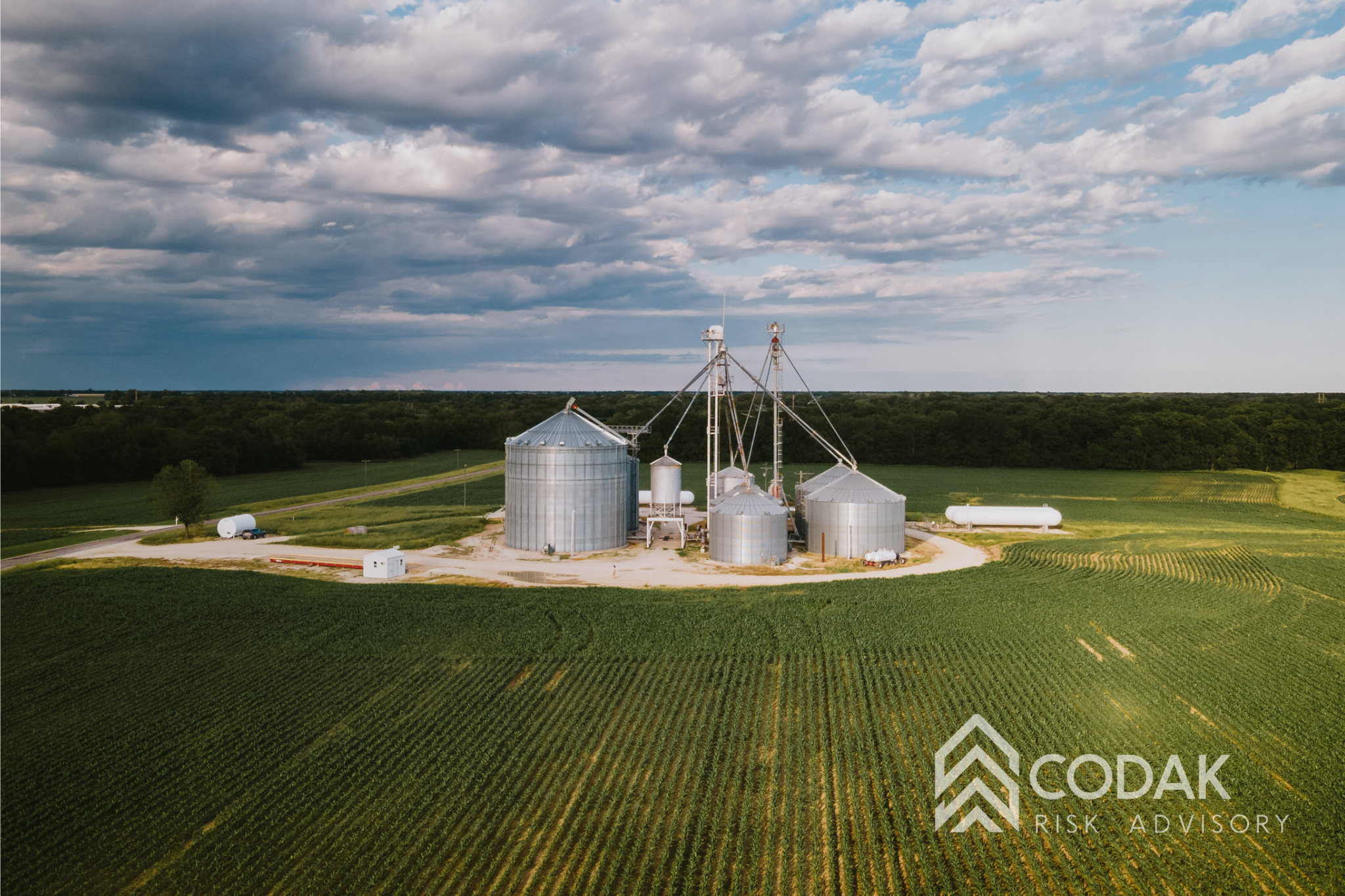
Strong corn demand remains in place, but the absence of Chinese buying and favorable weather has shifted market sentiment sharply lower. (Image from Real Ag Stock)
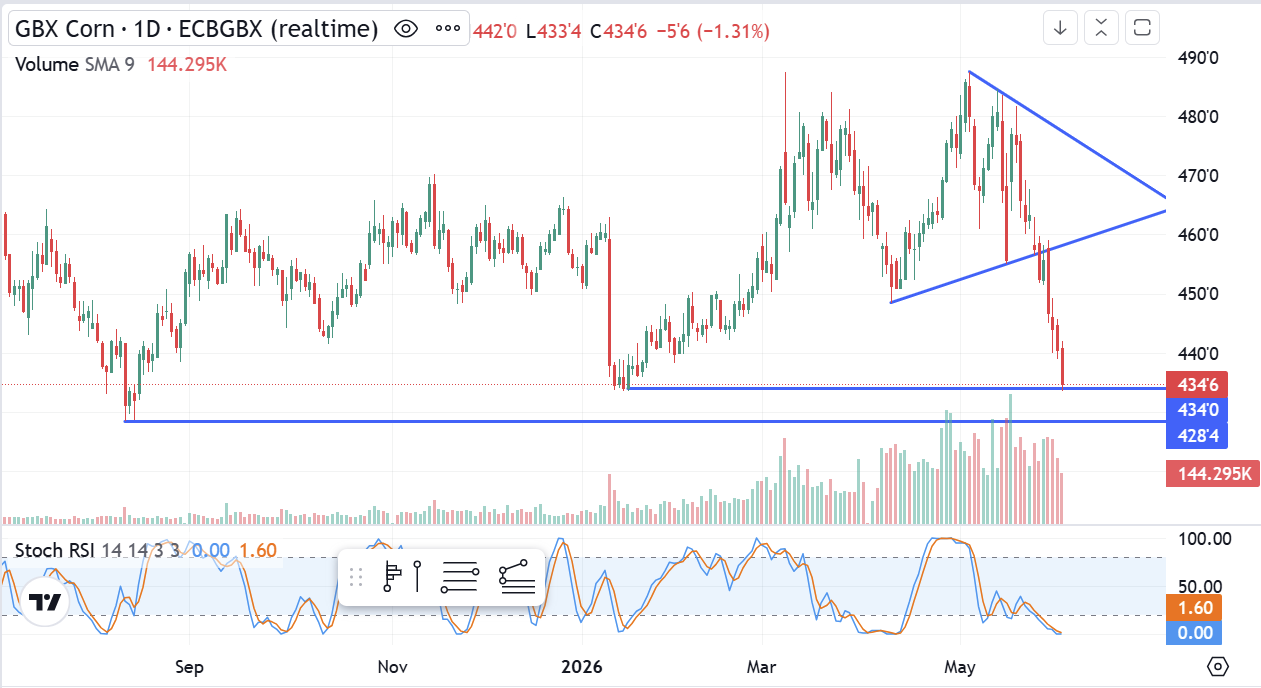
Corn has experienced a sharp breakdown from its consolidation range following the May 19th price peak. Since then, the market has posted only two positive sessions, underscoring the intensity of the selling pressure.
Open interest topped just ahead of that peak and declined through late May as Managed Money began liquidating long positions.
This wav entum indicator isn’t much comfort, but we’ll see who wants to be a seller of sub-430 corn before June 5th. e of selling came on the heels of optimism surrounding a China agreement to purchase significant volumes of U.S. commodities. However, that narrative has yet to translate into actual demand.
With no meaningful follow-through buying from China, no clear-cut weather threat, and growing trader fatigue tied to ongoing geopolitical headlines—particularly the “he said / she said” developments surrounding Iran—the market has struggled to find fresh bullish inputs. All of this is occurring as corn moves into the softer side of the spring/early summer seasonal window.
From a technical perspective, we’ll find out soon if the market will respect prior lows for the July 2026 contract. The continuous contract still has a gap open at $4. When a speculator is trapped and wants out of an oversold mom
Demand Remains a Bright Spot
Despite recent price weakness, underlying demand remains constructive:
Ethanol Demand
Ethanol: Margins are strong, supporting near-record production levels. While ethanol stocks are above historical norms, steady demand continues to prevent burdensome accumulation.
Export Demand Continues to Impress
U.S. corn export sales continue to exceed expectations.
Key export metrics include:
The 5-week average pace is running roughly 3.5x the rate required to meet USDA projections.
With just over 14 reporting weeks remaining, only 8.3 million bushels per week are needed to hit USDA’s 3.3 billion bushel target.
The current 4-week trailing average sales sit above 51 million bushels per week.
The China Wildcard
From a demand perspective, if USDA’s Supply & Demand projections are accurate, China’s corn stocks continue to tighten. That dynamic—combined with cheaper global corn values, elevated energy prices, and the geopolitical incentive to maintain favorable trade relations with the U.S.—creates a credible pathway for increased Chinese imports. If realized, that shift could materially tighten the U.S. balance sheet from current carryout estimates.
However, until China actively steps into the market, this remains a risk factor rather than a demand certainty—one with a definable probability, but not yet a measurable impact. The absence of confirmed Chinese buying looms large, and even if purchases were to emerge, questions remain about the U.S.’s ability to execute at scale from a logistical standpoint. Adding to the uncertainty, USDA continues to offer limited clarity on the Feed and Residual category, leaving a key demand component open to interpretation.
Weather: Not a Market Driver (Yet)
From a production standpoint, there is little in the current US forecast to disrupt the bearish momentum.
Current Weather Highlights
Drought conditions remain largely confined to the Southeast and parts of the western Southern Plains.
Forecasts call for active thunderstorm patterns progressing eastward from the Plains into the Midwest.
Temperatures are running above normal, but not yet at levels that threaten yield potential in a meaningful way.
At this stage, weather is not forcing a reassessment of supply, nor is it prompting speculative re-entry on the long side.
Big Picture
Recent WASDE reports show global corn stocks in a position broadly similar to this time last year—but at higher price levels.
That context reinforces the idea that the market had limited tolerance for disappointment.
When bullish expectations—namely, China demand and weather risk—failed to materialize, liquidation followed quickly.
Bottom Line
The selloff in corn has been driven less by weakening fundamentals and more by the unwinding of expectations:
Managed Money exiting a crowded long position
Chinese demand failing to materialize
Non-threatening weather conditions
Seasonal tendencies are turning less supportive
Demand remains objectively strong—but not strong enough, on its own, to offset the loss of a bullish narrative.
Until weather becomes a concern, China meaningfully steps in, or supply expectations tighten, rallies are likely to be viewed as selling opportunities within the current framework.
Disclosure: CODAK Risk Advisory, LLC and Lakefront Futures and Options, LLC are providing this communication for informational purposes, and it is not a solicitation or offer to purchase or sell commodities. CODAK Risk Advisory, LLC and Lakefront Futures and Options, LLC are separate entities. Lakefront Futures and Options, LLC is registered with the National Futures Association (NFA) as an introducing broker. Any recommendations, signals, or comments made in this communication do not consider any individual's or company's objectives or needs, which should be considered before engaging in any commodity transactions based on the content herein. The sources for the information in this communication are believed to be reliable, but neither CODAK Risk Advisory, LLC nor Lakefront Futures and Options, LLC warrants or guarantees the accuracy of the information. Past performance is not indicative of future results. CODAK Risk Advisory, LLC, Lakefront Futures and Options, LLC, or their affiliates may hold or take positions for their accounts that are different from the positions recommended in this communication. Any material found in this communication is subject to change without notice. Trading derivatives is risky and is not suitable for everyone. Reproduction is prohibited without the consent of CODAK Risk Advisory, LLC .

Garret Brown
Founder | Market Advisor
Having grown up on a farm, Garret respects the wide range of skills needed to run a successful operation and recognizes farmers are often stretched thin trying to do it all. This understanding, along with his affinity for markets, fuels his drive to make tough marketing decisions simpler for farmers.
Leveraging his experience in grain origination and margin management, Garret analyzes technical and fundamental market information. With the assistance of CODAK’s algorithmic signaling platform, he puts together buy/sell recommendations while working with the CODAK team to create strategies that accommodate each farmer’s personal risk tolerance, on-farm storage capacity, and break-evens.