
Corn vs. Spring Wheat: A Fringe Area Decision

Are corn acres on the verge of losing ground to… spring wheat? That may be the case in northern fringe areas, where producers are paying close attention to market signals.
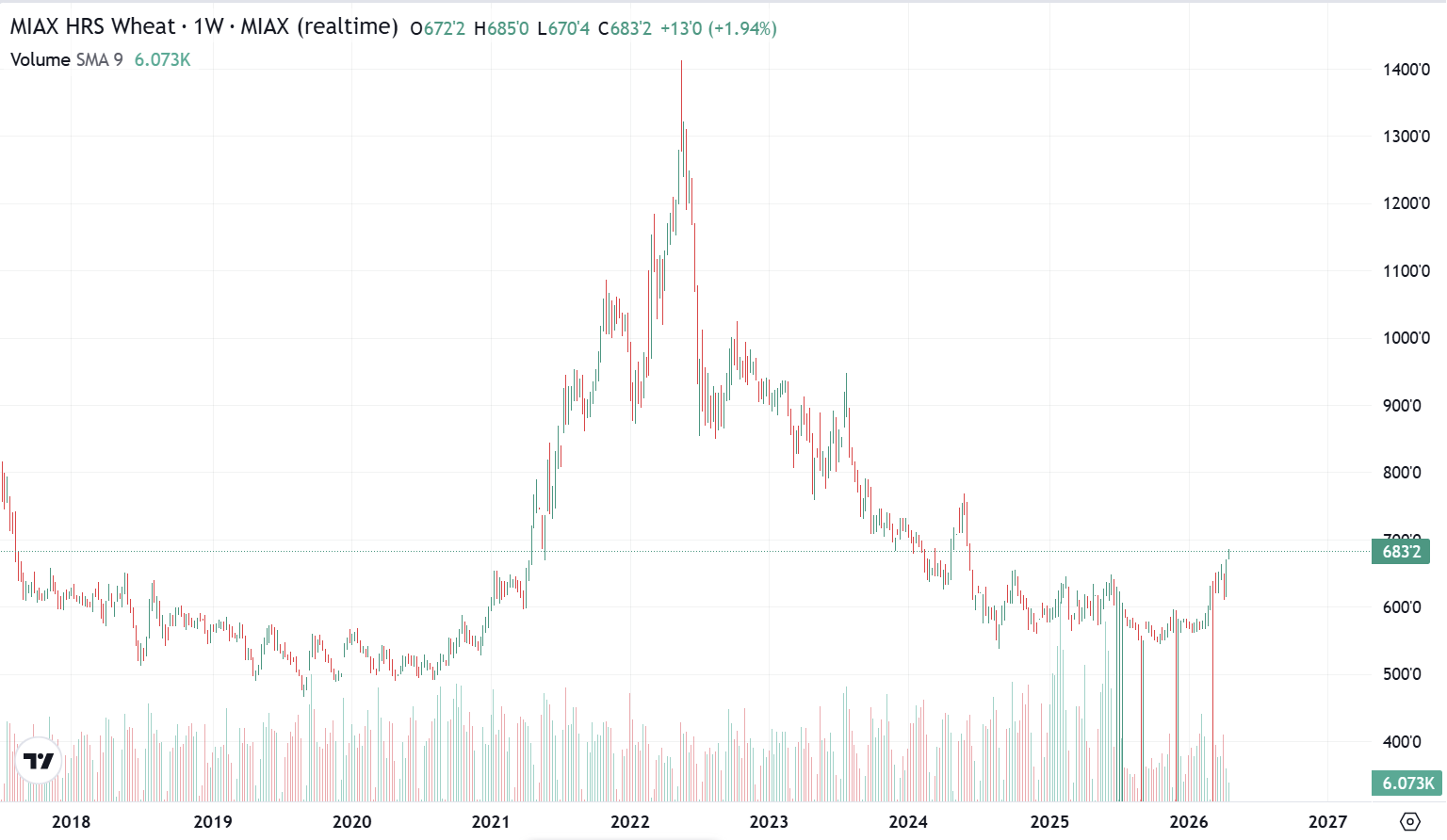
Dec corn closed at 4.81’6 on Tuesday, April 21, with a long-standing range of 4.45–4.95 holding firm since December 2023. Meanwhile, September spring wheat has rallied from 6.20 in January to 7.00 on the MIAX futures board, including a nearly 60-cent swing in just the past two weeks. Over that stretch, wheat has clearly outperformed corn.
Weather Risk and Planting Delays
These regions already face a higher risk of crops finishing late, often pushing harvest into snow conditions. Recent weather has delayed planting progress, making an early start unlikely and increasing the chances that seed will be returned. That delay alone begins to shift the risk profile between crops and forces growers to reconsider their planting mix.
Revisiting Crop Budgets
Looking at crop budgets, North Dakota State University estimates 63 bushels per acre for spring wheat and 142 for corn, with total costs at $410 and $576 per acre, respectively. However, those figures feel understated by this region’s high-quality soils. A more realistic pre-season outlook would be closer to 75 bushels per acre for wheat (with a range of 60–95) and 160 for corn (range of 135–200). Costs also likely run higher, with reasonable estimates around $475 per acre for wheat and $650 for corn.

Image from Real Ag Stock “Early Growth of Corn vs Spring Wheat “
Revisiting Comparison: Corn vs Wheat
Using current market conditions, corn in the northern Red River Valley is facing a basis near -75 against December futures, putting cash prices around $4.07 per bushel, or roughly $651.20 per acre in gross revenue. That figure doesn’t account for drying costs, which become significant given the likelihood of late planting and high-moisture harvest conditions. Many operations in the region are not well-equipped with adequate drying or storage capacity, making corn more difficult to manage.
Spring wheat, while producing less volume, offers a simpler logistical path. With a board price near $6.94 and local basis between -75 and -80 for September delivery, harvest cash prices come in around $6.19 per bushel, or $464.25 per acre. However, the opportunity improves when considering carry. The September-to-March futures spread is currently around 21 cents, putting March futures near $7.15. A -30 basis, which has been historically achievable, would result in a cash price near $6.85 and gross revenue around $513.75 per acre. For many farms, wheat is easier to store and manage, making it more appealing despite the lower upfront revenue.
Operational Reality Favors Wheat
Many farms in these regions aren’t equipped to grow corn:
Limited drying capacity
Storage constraints
Higher handling risk
Wheat, on the other hand:
Requires less storage volume
Is easier to manage post-harvest
Offers flexibility to “store and wait”
This makes it a more practical option for many farms, especially in a year with delayed planting.
Market Signals and Strategy
The market structure reinforces this perspective. Current spreads suggest no immediate shortage of wheat, but they do reflect potential tightening in new crop supply. The September–March carry had previously widened to 30 cents before narrowing back to 21, while the May–July 2026 spread sits near 18 cents. Historically, these carries have expanded to 25 cents or more by mid-August, with the past two years even exceeding 35 to 45 cents, offering opportunities to roll hedges forward and capture carry.
Final Thoughts
Will this shift move the corn market? Probably not.
But it could be enough to push meaningful acres back to spring wheat. If that happens, it could subtly influence wheat markets, particularly as U.S. offers remain above global competition and begin to weigh on export demand.
Source: NDSU Crop Budget Link > Projected 2026 Crop Budgets: North Valley North Dakota (EC1656)

Garret Brown
Founder | Market Advisor
Having grown up on a farm, Garret respects the wide range of skills needed to run a successful operation and recognizes farmers are often stretched thin trying to do it all. This understanding, along with his affinity for markets, fuels his drive to make tough marketing decisions simpler for farmers.
Leveraging his experience in grain origination and margin management, Garret analyzes technical and fundamental market information. With the assistance of CODAK’s algorithmic signaling platform, he puts together buy/sell recommendations while working with the CODAK team to create strategies that accommodate each farmer’s personal risk tolerance, on-farm storage capacity, and break-evens.