
Hedge, Insure, or Wait? Fall Trade-Offs Before Harvest
Driving the combine may be more fun, but don’t push off the financial decisions. September 30 is a key deadline.
“Plans are worthless, but planning is essential”
— Dwight D. Eisenhower, General
“There are no solutions, only trade-offs”
— Thomas Sowell, Economist
One of my favorite quotes comes from Eisenhower because it captures good business sense: no plan is perfect, but the process of planning is indispensable—we need to think ahead and adapt.
During this rally, our team kept coming back to Sowell’s point as we thought through opportunities for clients. Hedging can cost opportunity if the rally continues; doing nothing can cost good sales if geopolitical premium erodes and prices sell off sharply.
In complex systems, there usually aren’t perfect solutions—just trade-offs.
Given those two thoughts, farmers can’t lose sight of financial decisions as harvest begins. I get it—running the combine is more fun than running numbers—but don’t let the office work disappear.
ARC or PLC Payouts
The One Big Beautiful Bill allows farmers for 2025 only to get the higher of the two programs Area Risk Coverage – County (ARC-CO) or Price Loss Coverage (PLC). There’s nothing to do on your part except estimate what may be coming for cashflow heading into harvest.
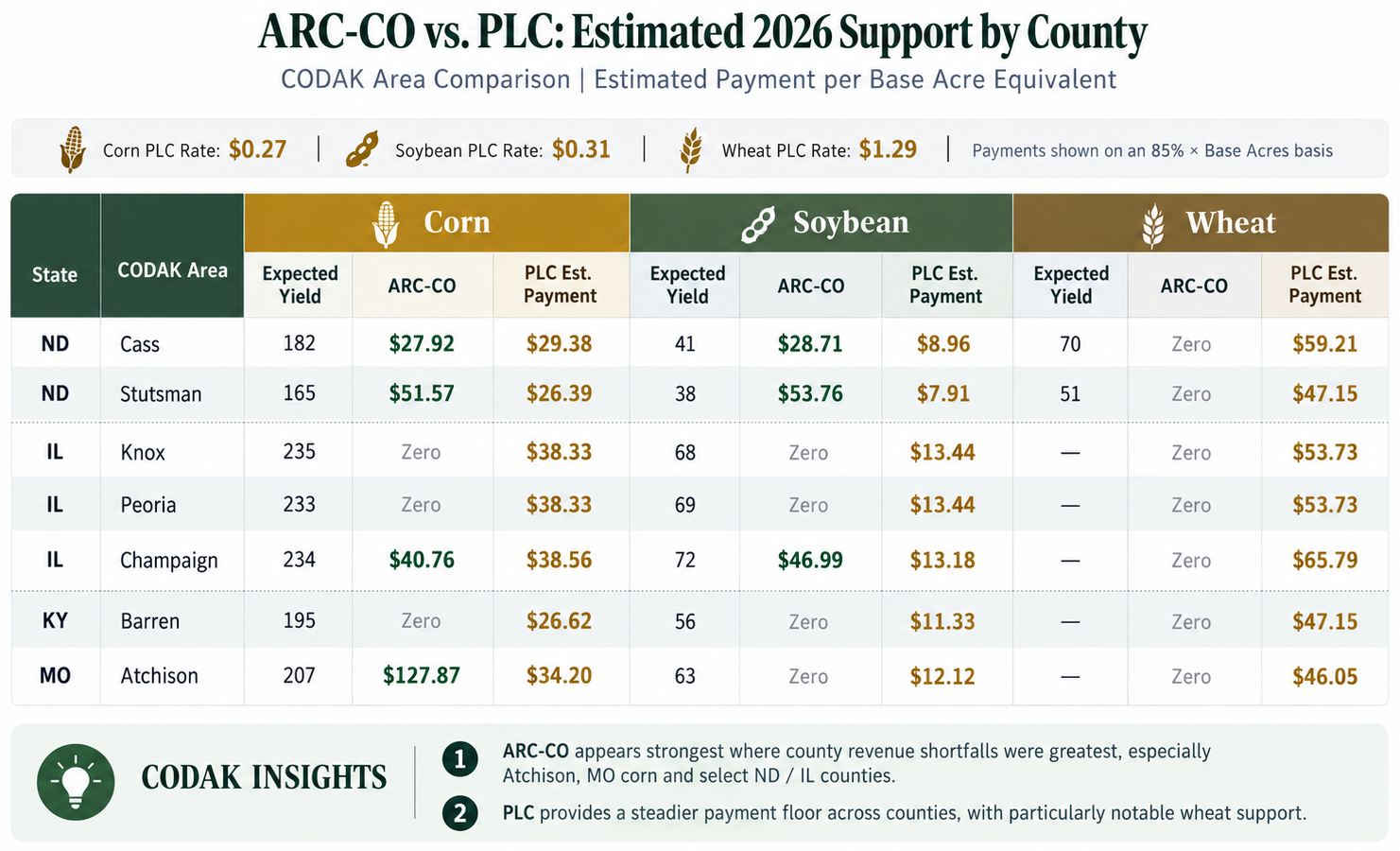
PLC is a put option on the national MYA price with a farm-specific fixed number of bushels attached to each base acre.
ARC-CO is a county revenue protection built on a rolling county benchmark.
If you want CODAK to analyze your farm, request the 2025 form FSA-156EZ Farm Records from your local office. You may also look at this resource from Kansas State University to see other county estimates.
Our PLC numbers used county PLC averages, but your individual farm will vary.
That potential payment matters for cash flow, so take a few minutes to estimate what may be coming to your farm.
Hedging Next Year’s Crop
Should you begin marketing next year’s crop?
Some talking heads are predicting $6 or even $7 corn. That would be sweet (for the grain guys), but demand destruction is a real thing (the livestock guys need to buy it, remember?).
The key consideration is your fixed costs per acre. Remember, the landlord and banker will “eat at the trough” before you do. You know many of these expenses' months or even years in advance.
On my farm, if I can hedge a smaller percentage of conservative production than the percentage of costs those sales lock in, that’s a win for a long-term hedge even if it “looks bad” months later.
After all, we can always re-own later.
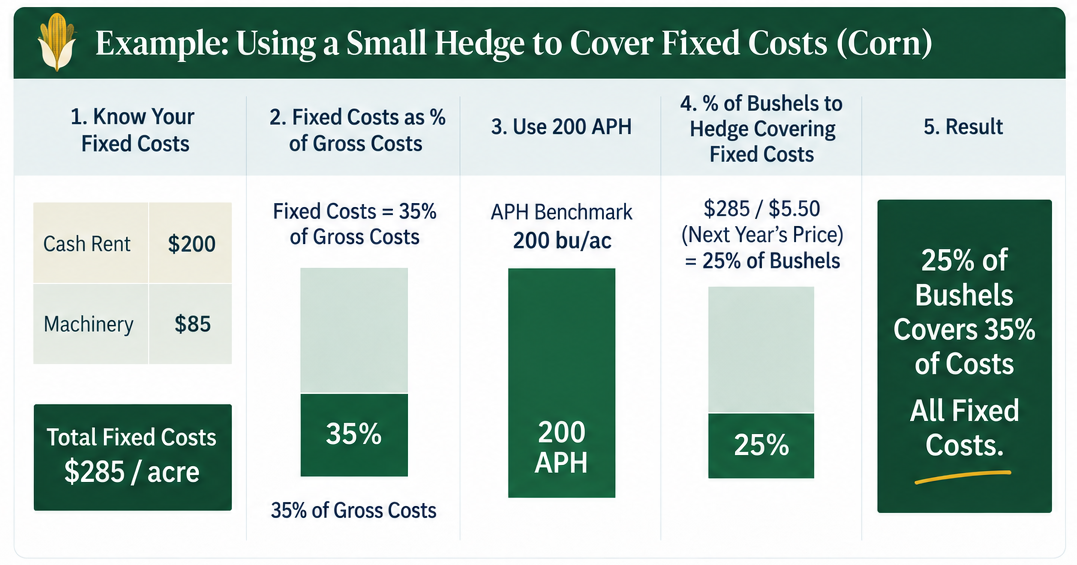
For example, suppose a corn grower has about $285/acre of fixed costs—roughly 35% of gross costs—and a conservative 200-bushel APH. At $5.50 corn, hedging roughly one-quarter of expected production can cover those fixed costs.
Why not at least consider starting there?
Fall Crop Insurance
There’s another way to put some early margin protection on books.
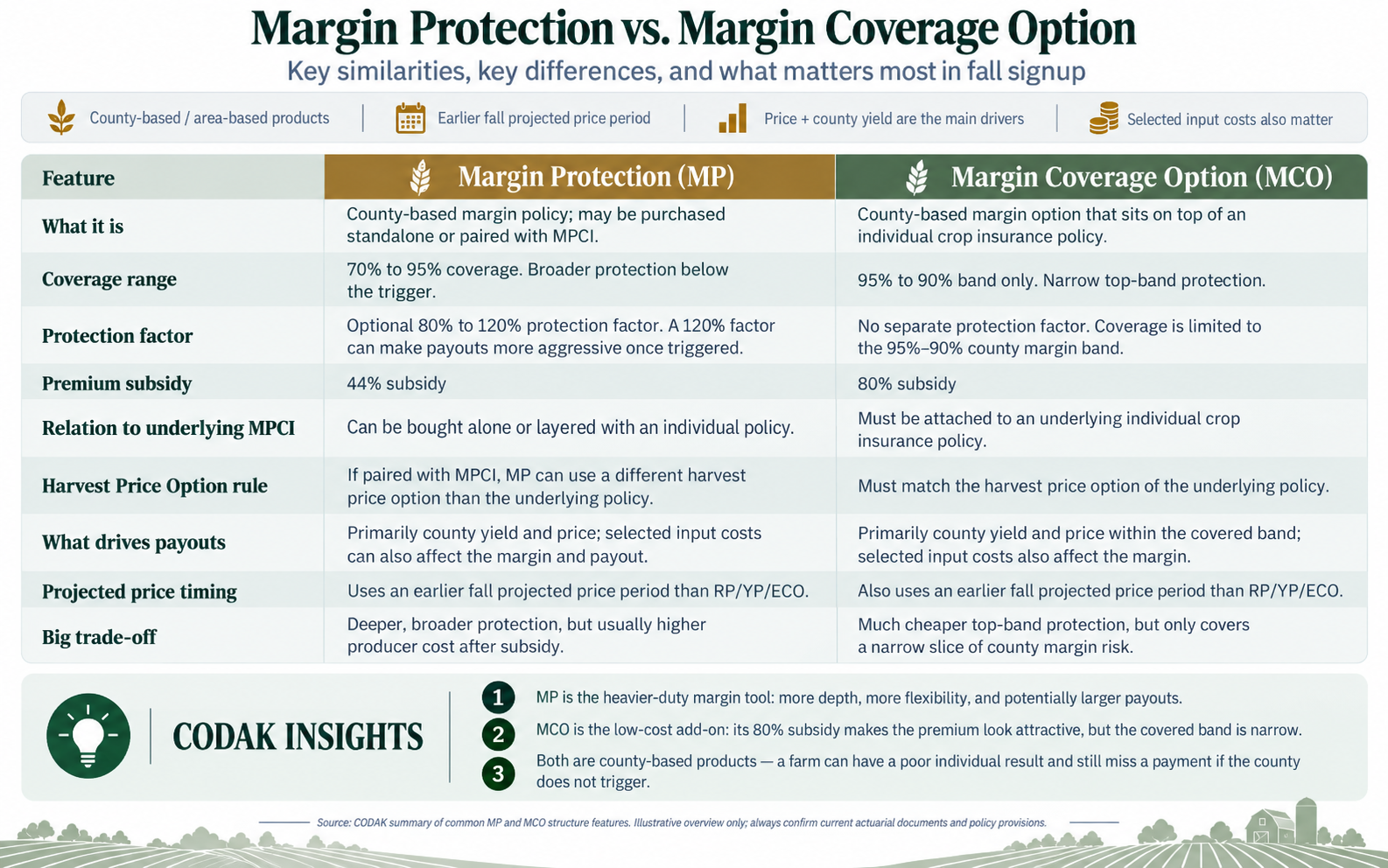
This recent bull rally has forced another look at fall crop insurance options. Margin Protection (MP) and Margin Coverage Option (MCO) are county-based plans that are particularly interesting after the remarkable run-up in August.
Their margin projected-price discovery period runs August 15 through September 14, so this rally is being captured directly in the price used to set up next year’s coverage. That makes them worth comparing with a traditional early hedge.
MP has been around for several years. You’re not ensuring revenue; you’re insuring margin. Changes in specified input prices can affect the payout, but county yield and commodity price are usually the big movers.
Practically, that means MP can behave a lot like county-level revenue protection, but it is not the same thing as ECO or an individual RP policy.
MCO is the newer hybrid: it uses a margin trigger like MP but sits on top of an individual crop insurance policy like ECO. For 2027, it covers only the 95%-to-90% band. That is much narrower than MP, but the 80% subsidy makes the producer-paid premium considerably cheaper.
Hedge? Insure? Both? Neither?
Let’s look at selected counties in the CODAK network for comparison.
It is not a perfect apples-to-apples comparison, but we can put producer-paid crop insurance premiums beside estimated futures margin collateral and express both on a per-bushel basis.
The useful question is not simply which tool is cheaper—it is what each tool costs and what risk it actually transfers.
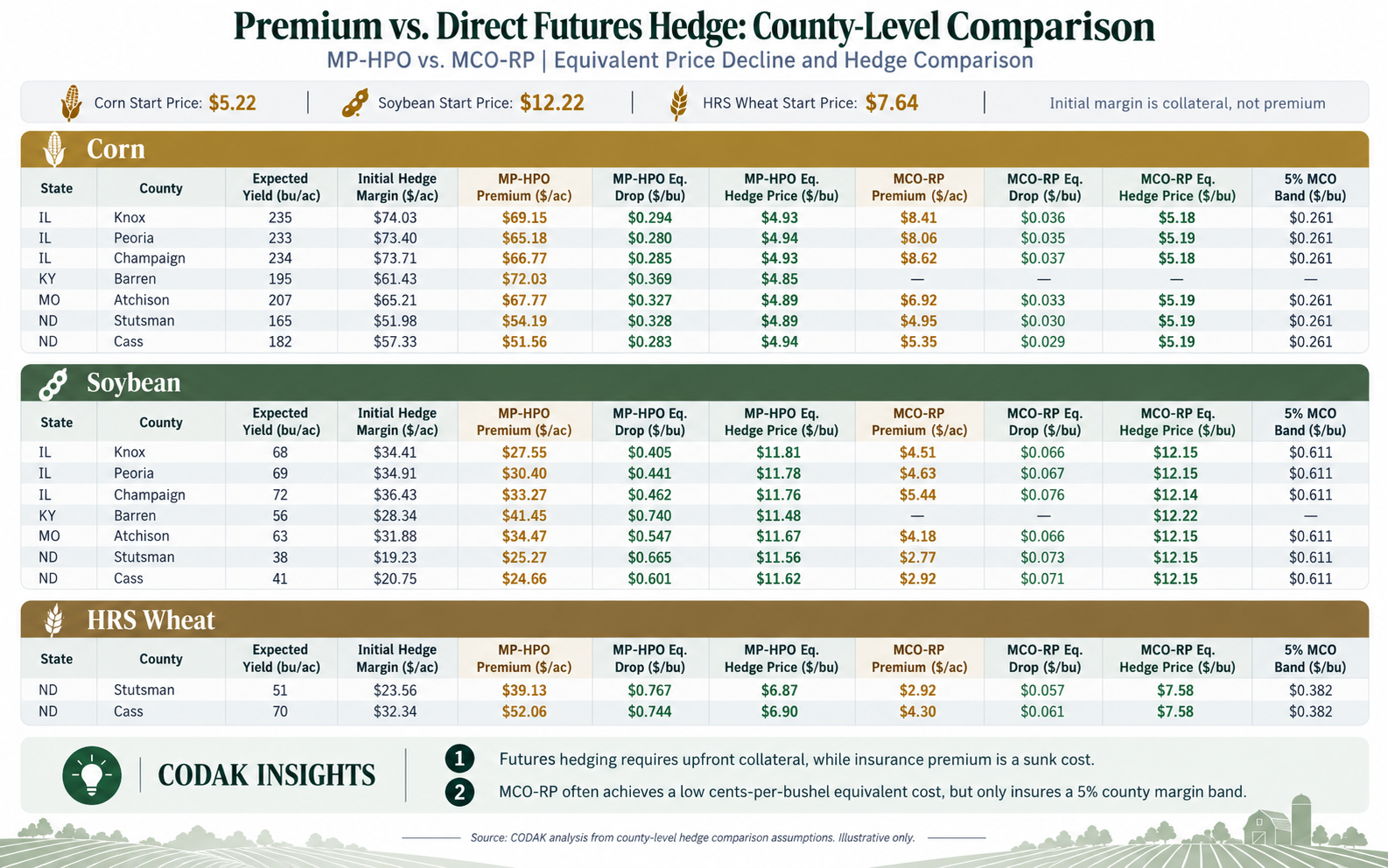
Crop insurance premium is a non-refundable cost. Initial futures margin is collateral—it is not the cost of the hedge, but it must be funded and managed as the market moves.
The table above assumes a 100% hedge only to create a common per-acre comparison; that is not something we recommend as a default.
MP and MCO are also county-based plans, so farmers need to consider how closely their individual farms correlate with county results.
Champaign County, IL Corn
MP with Harvest Price Option (MP-HPO) costs $66.77/acre. Spread across 234 expected bushels, that is about $0.285/bu; a futures decline from $5.22 to about $4.93 would generate hedge gains equal to the premium.
That is not the same thing as MP coverage—the policy also carries county-yield and input components—but it gives us a common price-only yardstick.
MCO-RP costs $8.62/acre, or about $0.037/bu, so the equivalent futures move is only to about $5.18. That lower producer cost is the attraction; the trade-off is that MCO only protects the narrow 95%-to-90% band.
Atchison County, MO Soybeans
Soybeans have a greater margin burden per acre because of the higher contract value, but the same premium-equivalent approach works.
In Atchison County, MP-HPO costs $34.47/acre, or about $0.547/bu, so a move from $12.22 to about $11.67 would generate hedge gains equal to the premium.
MCO-RP costs $4.18/acre, or just $0.066/bu, for an equivalent futures price near $12.15. Again, cheap top-band coverage—but only for that 95%-to-90% slice.
Cass County, ND Wheat
At a $7.64 fall wheat price, Cass County MP-HPO costs $52.06/acre, or about $0.744/bu. That puts the premium-equivalent futures price at about $6.90.
MCO-RP costs $4.30/acre, or about $0.061/bu, putting the comparable futures price near $7.58.
There Are No Solutions—Just Trade-Offs
As Sowell notes, there are no solutions—just trade-offs.
Hedging offers flexibility and direct price protection, but no county-yield or input component, and it creates liquidity and management demands.
MP can provide much deeper protection and, at a 120% protection factor, can pay much more aggressively once triggered—but it is not cheap.
MCO’s 80% subsidy makes the producer-paid premium attractive, but the coverage is deliberately narrow.
The right answer may be hedge, insure, both, or neither; the point is to make that decision deliberately.
The margin projected-price discovery period runs through September 14, and the September 30 sales closing date comes fast. Many of us will probably be harvesting by then and won’t be interested in swapping the combine for a calculator, so do the thinking now.
Action Steps Before Harvest:
Estimate your 2025 ARC-CO or PLC payment. If you are enrolled in ARC-IC, analyze that separately. That money can reduce debt or help prepay next year’s inputs.
Put together a tentative crop plan for next year. Cost per bushel and crop mix matter before you harvest this year’s crop because agronomics starts the clock next year early. You need at least a starting point to decide whether you should hedge or insure.
Look at current deferred prices. Do they justify locking in enough bushels to cover fixed costs?
Compare MP and MCO with a traditional hedge. Should either complement—or replace part of—a traditional hedge?
Harvest has a way of consuming every available hour, but next year’s margin is already being built while this crop is still in the field.
Be safe first, then make the financial decisions deliberately: know the cash coming in, know the fixed costs going out, and decide what risk you want in the market—or crop insurance—to carry.
The goal is not to predict the top; it is to enter the next crop with a plan you can adapt to.
Disclaimer: Trading futures, options, and cash grain markets involves substantial risk. The information contained in this article reflects the opinions of the author and is intended for informational purposes only. It does not take into account the specific financial circumstances, objectives, or risk tolerance of any individual. Consult with your financial, marketing, or risk management advisor before making any decisions based on the information discussed in this article.

Andrew Bowman
General Manager - Insurance| Market Advisor, Central Midwest
A former client turned Market Advisor, Andrew, oversees Illinois and the surrounding region. He also leads the CODAK Insurance Group, integrating crop insurance into our clients’ marketing strategies. His focus is on helping clients make confident decisions, gain peace of mind, and protect their working capital.
Connect with Andrew