
Creating Knowns, Reducing Unknowns — Hedging Against Next Year's Inputs
We haven't finished harvesting this year's crop yet, but it's already time to plan for next year. How should marketing play a role?
Uncertainty is a fact of farming. Right now, we know very little about what next year's crop will ultimately produce, what it will cost, or what we'll receive for it.
Between now and harvest next fall, we'll make hundreds of decisions that gradually turn some of those unknowns into knowns. Others will remain uncertain until the crop is in the bin.
As harvest rolls on, we're already making decisions that influence next year's crop.
Is the combine set correctly for proper residue management?
Should I harvest this field first so it can be fertilized before conditions turn wet?
How many units of nitrogen should be fall-applied versus spring-applied?
Each decision can increase, decrease, or maintain our level of uncertainty.
Marketing fits into this differently.
It's one thing to optimize for the highest futures price. It's another to harmonize that objective with the best basis opportunity, cash-flow needs, and the best risk/reward ratio for your farm's risk tolerance.
Theoretically, if maximizing price were our only objective, we'd go 100% into every marketing decision, trading in and out of positions with fervor as conditions changed.
But we don't live in the theoretical field. Even professional speculators manage exposure and rarely go all-in on every trade.
If we're not going to go all-in with each decision, it makes sense to split our marketing into meaningful increments.
As our CODAK team articulates, marketing actions should be large enough to count.
For instance, if your corn crop is approximately 250,000 bushels, entering just two futures contracts—10,000 bushels, or 4% of production—probably isn't enough to meaningfully improve your average final sale price.
Yes, it also isn't enough to hurt your average if you're wrong. But consistently making small, inconsequential trades may indicate a lack of conviction or fear-based decision-making rather than a deliberate marketing strategy.
However, I'd argue there's one important instance where smaller, parceled-out trades make a lot of sense: hedging inputs incrementally.
Hedging What We Know
USDA just floored us by adding 2.7 bushels per acre to its estimated national corn yield, raising it from 178.5 to 181.2 bpa.
That came after September's yield reduction, and it certainly hasn't resolved the conflicting yield reports we're hearing from the countryside.
Whether we agree with USDA or not, decisions still need to be made for next year's crop.
That's why hedging against known input costs makes sense, even when the broader market outlook is uncertain.
Sticking with corn, what do we already know about next year's crop?
We know we'll need fertilizer, seed, land, and equipment.
On my farm, I know how many units of potash, anhydrous ammonia, MAP, and lime I'll be applying as harvest concludes. I've already contracted those inputs.
Once my plot is harvested, I'll use that data to finalize which seed hybrids I'll plant next year, but I already have a fairly good idea of what they'll cost.
I also know my per-acre costs for rent, land payments, and machinery payments.
These are expenses that aren't going away simply because corn prices have declined.
My last blog entry included an example of how a relatively small hedge could cover fixed costs. The same principle applies to variable costs like fertilizer.
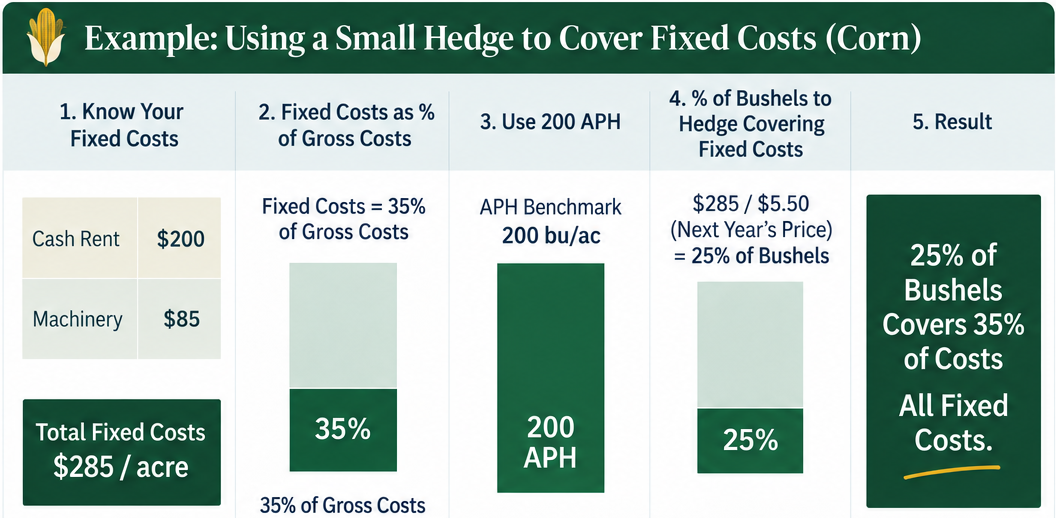
Since the market has dropped following USDA's latest WASDE report, I'm reluctant to make large sales simply for the sake of getting something priced.
But that doesn't mean we should stop marketing altogether.
This is where smaller, incremental hedges tied to specific expenses become especially valuable.
My Nitrogen Fertilizer Hedge
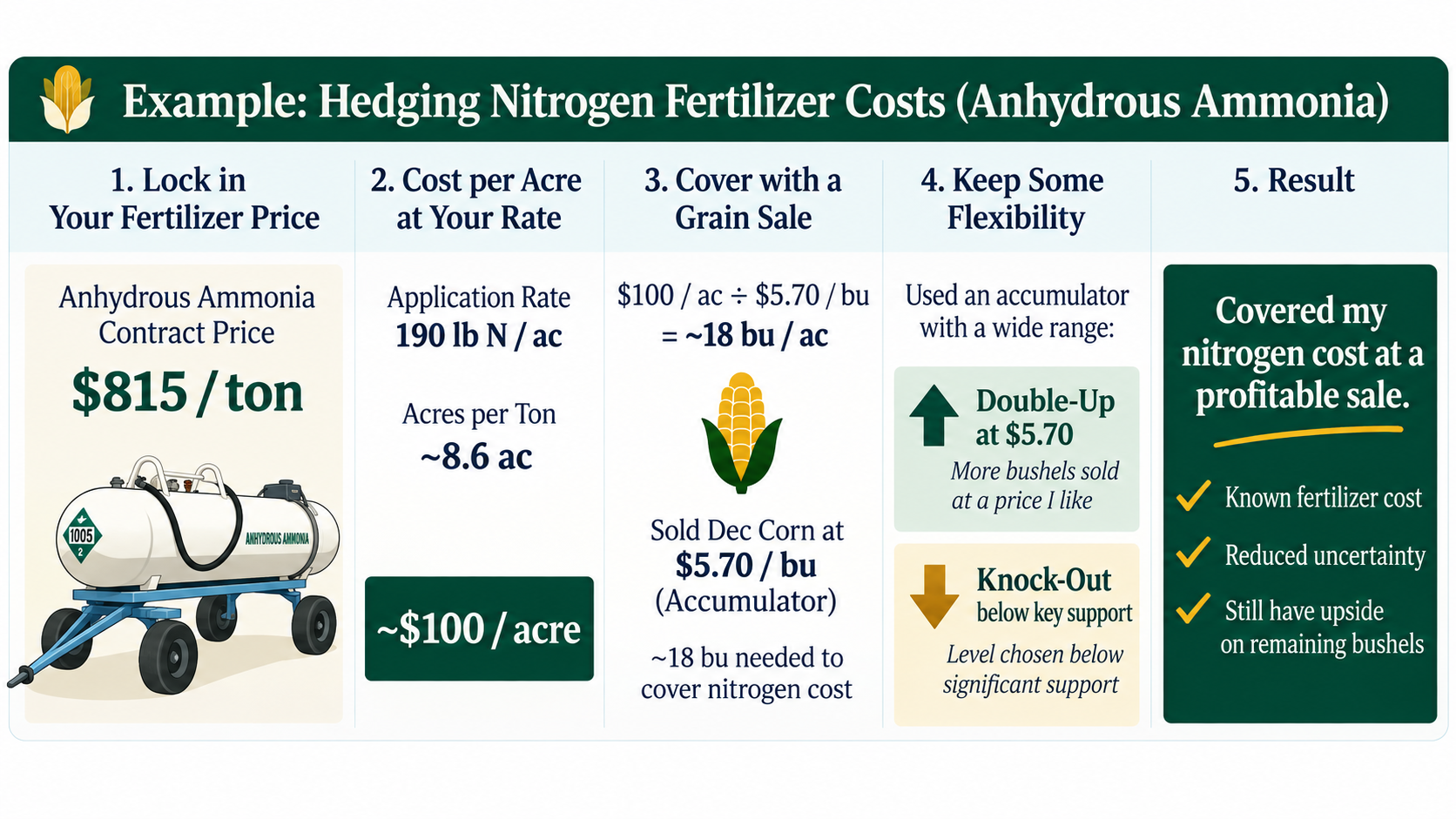
I locked in anhydrous ammonia at $815 per ton. At an application rate of 190 pounds of actual nitrogen per acre, one ton of NH3 covers approximately 8.6 acres, costing about $95 per acre for the fertilizer itself.
When I contracted the fertilizer a month ago, I also entered a corn accumulator at $5.70 per bushel, targeting roughly 18 bushels per acre to cover that expense.
Now, I recognize the accumulator could knock out or double up, creating its own source of uncertainty.
But hear me out.
Those were the risks I was willing to take. The knock-out level was below significant technical support, and a double-up at $5.70 wouldn't make me upset.
I was comfortable accepting those conditions in exchange for the opportunity to achieve a higher selling price.
I didn't eliminate uncertainty. I narrowed it.
Rather than leaving the entire fertilizer expense exposed to whatever corn prices might do, I established a sale strategy with defined conditions and a price I was willing to accept.
At the time, I could have simply sold futures at $5.36, the underlying market price on the day I entered the accumulator.
But that felt a little rushed. We were only a few weeks removed from USDA, reducing its national yield forecast to 178.5 bpa, and I wasn't ready to commit to a larger share of production.
The accumulator allowed me to pursue a higher price while accepting some additional risks.
Today, with the market lower, that $5.36 futures opportunity looks pretty good. But rather than dwell on a missed opportunity, I can point to the incremental decision I did make.
I paired a known input expense with a targeted grain sale at a price that more than covers the fertilizer cost—provided the accumulator fulfills the intended bushel commitment.
That's a meaningful step toward reducing uncertainty.
Creating Knowns Reduces Unknowns
Our founder, Garret, has made this a key point when coaching CODAK clients: reduce unknowns by creating knowns.
It's not always about maximizing futures price!
Turning unknowns into knowns has real value for your farm.
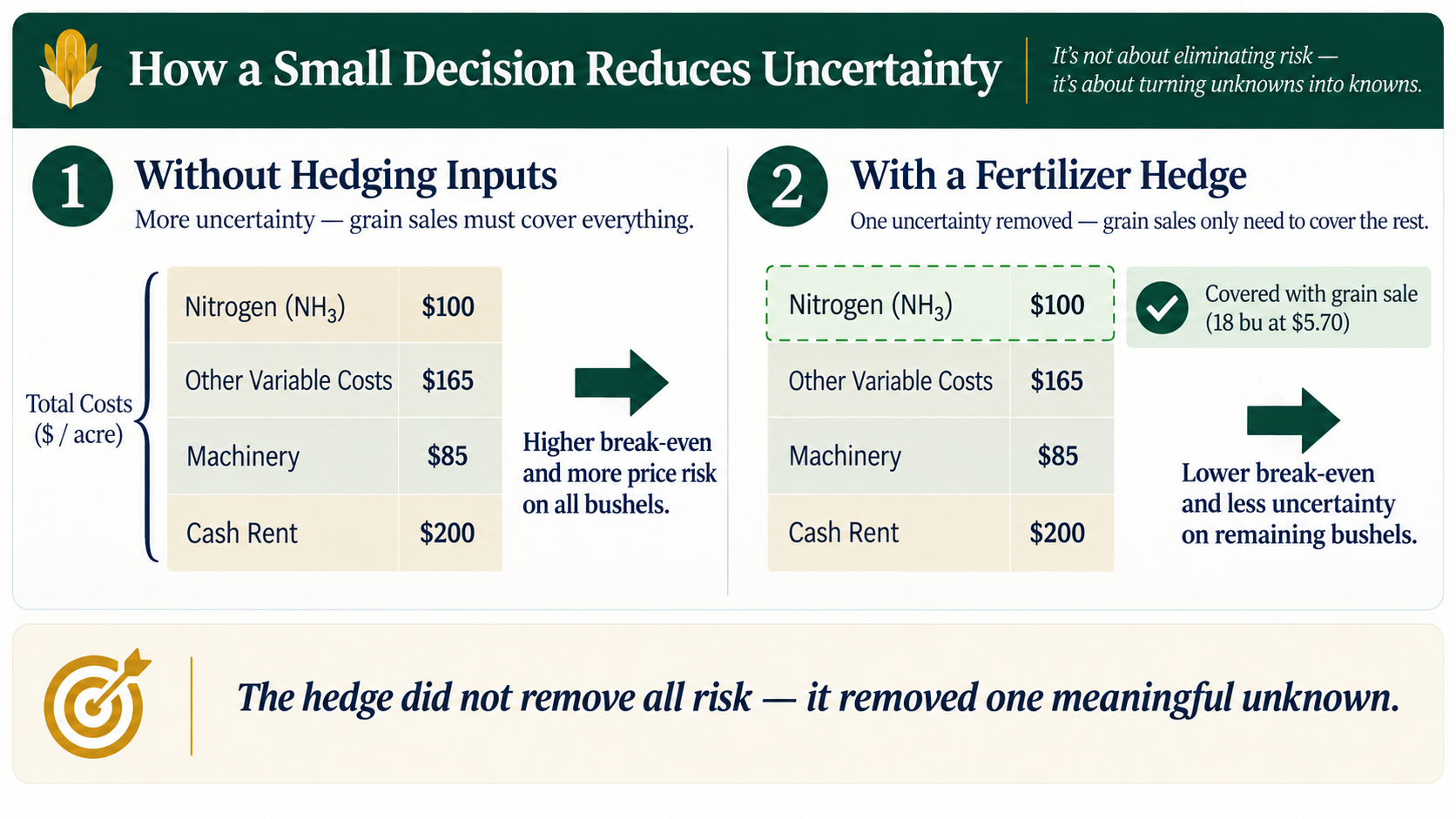
In this example, I've locked in my nitrogen purchase price and established a marketing position designed to cover that cost at a profitable selling price.
There is still uncertainty. The accumulator has conditions that could affect the number of bushels ultimately priced, and plenty of my future corn production remains unsold.
But to the extent this hedge is completed as intended; those remaining bushels no longer have to shoulder the nitrogen expense. They can contribute toward covering other costs and ultimately generating profit.
That is a meaningful improvement in my farm's risk position, even though the transaction represents only a small percentage of total production.
The Bottom Line
The reality of marketing is that we don't JUST optimize futures price. We also manage cash flow, protect profitability, and reduce risk and uncertainty.
A recent downturn in the market shouldn't automatically prevent us from making smaller, deliberate hedges against inputs.
When those hedges are tied to real expenses, even a modest grain sale can remove a meaningful piece of uncertainty from the farm P&L.
A small sale may not move your average selling price very much. But if it covers an expense, you know is coming; it may accomplish far more than the percentage of production suggests.
Sometimes the best marketing decision isn't about how much more you can make. It's about how much less you have left to worry about.
Disclaimer: Trading futures, options, and cash grain markets involves substantial risk. The information contained in this article reflects the opinions of the author and is intended for informational purposes only. It does not take into account the specific financial circumstances, objectives, or risk tolerance of any individual. Consult with your financial, marketing, or risk management advisor before making any decisions based on the information discussed in this article.
Accumulators Note: Accumulator contracts have conditional pricing and quantity provisions, including potential knock-out and double-up features. Actual bushels priced and final financial results depend on the specific contract terms and market movements.
Andrew Bowman
General Manager - Insurance| Market Advisor, Central Midwest
A former client turned Market Advisor, Andrew, oversees Illinois and the surrounding region. He also leads the CODAK Insurance Group, integrating crop insurance into our clients’ marketing strategies. His focus is on helping clients make confident decisions, gain peace of mind, and protect their working capital.
Connect with Andrew