
Performance and Profit, Not Hours and Inputs
Image from Real Ag Stock
Work smarter—not harder—applies to your farm, but it’s nuanced
Past generations often scoff that younger farmers couldn’t have survived the way they did. Younger generations counter that times have changed—and they’re not wrong. The farm community has long held work ethic as one of its highest virtues, and rightly so. But today’s farmers are also seeking balance.
Objectively, both perspectives hold truth.
Running a farm, or any business, is difficult. Resources are limited. Time is finite. The question becomes: how do we achieve greater success?
The old-school mentality demands more hours, more discipline, more focus. But more hours and more inputs will only take us so far.
A Look at the Numbers
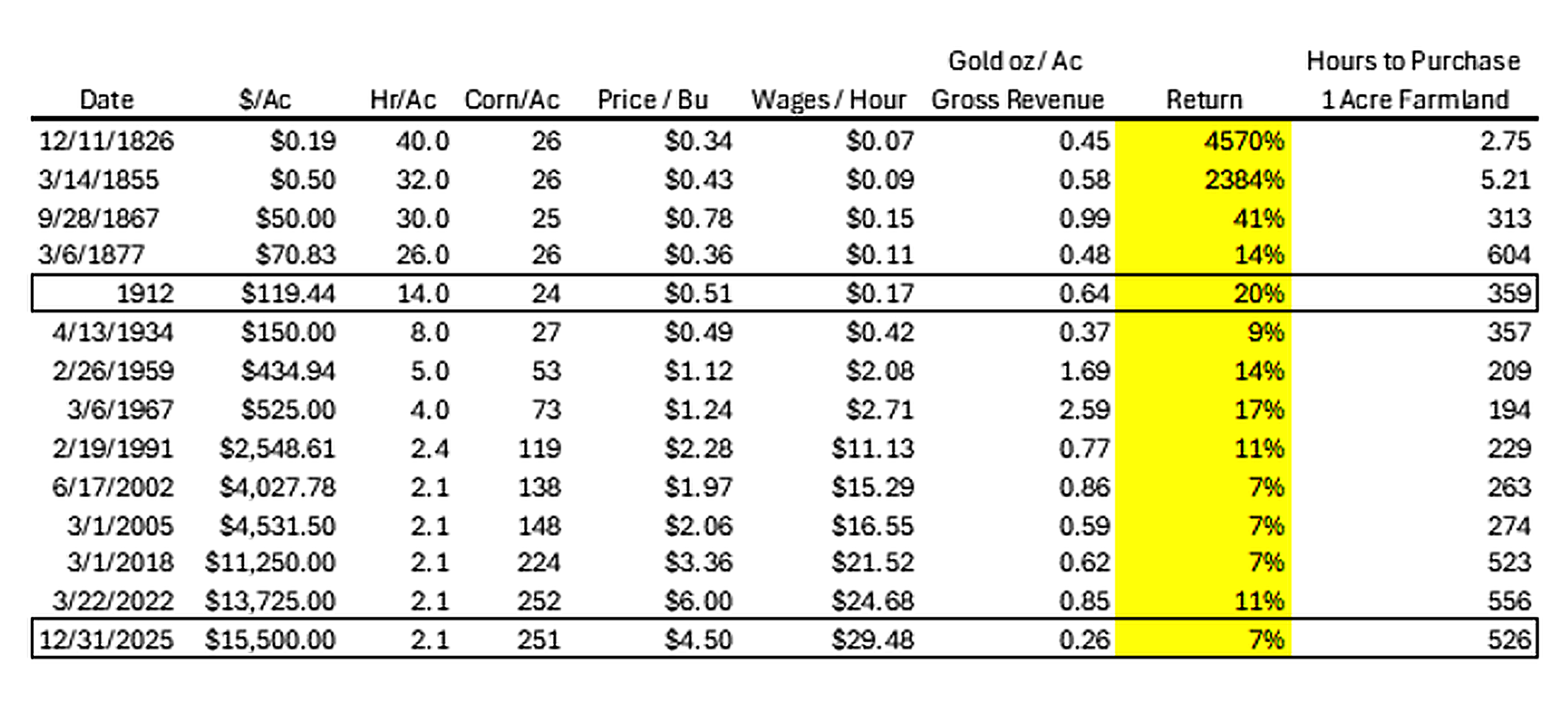
To better understand this, I researched land sales on our family farm and comparable nearby properties. The earliest recorded sale dates back to 1826, when land was distributed to Revolutionary and War of 1812 veterans. My own data begins in 2005.
To make meaningful comparisons, I adjusted for inflation using gold as a proxy, analyzed average corn yields, price per bushel, labor hours per acre, and hourly labor value.
Key Takeaways
Revenue vs. Land Value: Gross revenue per acre has historically ranged from 7%–20% of farmland value (excluding extreme early periods). Today, we’re at the low end—below even Great Depression levels.
Labor vs. Ownership: Labor no longer converts to capital like it once did. In 1967, my grandfather needed 194 labor hours to buy one acre. Today, it takes 526 hours.
Historical Comparison:
1877: $70.83/acre, ~25 BPA, 14% return
2025: ~$15,500/acre, 251 BPA, 7% return
1912: Peak performance at ~20% return—The “Golden Age of Agriculture”
If parity pricing returned (based on 1912), corn would be around $16.40/bu in 2026—but don’t count on it.
Will Working Harder… Work?
Let’s assume a farmer works 60 hours/week, 51 weeks/year. That effort might purchase 5.8 acres annually, excluding living expenses.
Push it to the extreme—minimal sleep, no life—and you could reach 12.5 acres/year.
Over a 50-year career:
Balanced life: ~291 acres
No-life grind: ~625 acres
Doubling acreage sounds appealing—but it’s not realistic or sustainable. And even then, it’s often not enough to support a modern farming operation.
In the 1960s, a half section could support a family. Today, that same land might be considered a “farmette.”
Will Higher Yields Solve It?
In 2022, our farm saw yields increase by 28 BPA compared to 2018, with better prices. Returns improved from 7% to 11%.
Image from Real Ag Stock
Let’s push further. The 2023 Illinois NCGA Yield Champion hit 348 BPA. Applying that to our model yields roughly a 10% return—about 50% better than baseline.
That’s meaningful—and more scalable than adding hours.
But there’s a catch:
Yield gains often require higher costs
Weather variability adds risk
Profit—not bushels—matters most
What good is 348 BPA if your cost structure requires 375 BPA to break even?
Higher yields help—but they’re not the full answer.
You Can’t Outwork or Outyield Reality
So if more hours and more yield aren’t enough, what works?
In 10x Is Easier Than 2x, Dan Sullivan and Benjamin Hardy argue that income is tied to performance—not effort.
You’re paid based on the value you create.
Consider this: my 12-year-old runs the 100m dash. Usain Bolt ran it in 9.58 seconds—and earned $82M in 2025, years after retiring.
Same distance. Very different value.
What Does “Better Performance” Look Like?
One example is organic corn production.
Baseline estimates show returns increasing from 7% to 11%. With improved systems, better management, and investment in knowledge and infrastructure, returns could reach 15% or more.
That’s more than double the baseline—without simply adding hours or inputs.
This isn’t a call to go organic. It’s a call to rethink value.
Rethinking Work Ethic
We shouldn’t glorify all-nighters, skipped meals, and nonstop grinding as the only path to success.
Yes, work ethic matters—but it’s not everything.
You’ve seen it:
Some farmers never leave the field
Others make time for family, church, and life
And both still buy land.
At some point, the marginal return on extra hours drops off.
Did that 18-hour day really put you ahead of the farmer who worked 12–16?
Probably not.
What mattered more was how those hours were used—and the value they created.
Final Thought

Image from Real Ag Stock
As we enter the growing season, focus on performance—not just effort.
You won’t win with more hours alone. You won’t win with yield alone.
Take the time to eat with your family. Go to church. Step away when needed.
Because success isn’t measured in hours worked—it’s measured in value created.

Andrew Bowman
General Manager - Insurance| Market Advisor, Central Midwest
A former client turned Market Advisor, Andrew, oversees Illinois and the surrounding region. He also leads the CODAK Insurance Group, integrating crop insurance into our clients’ marketing strategies. His focus is on helping clients make confident decisions, gain peace of mind, and protect their working capital.
Connect with Andrew