
When Replanting Matters – The Market’s Worries and Your Worries
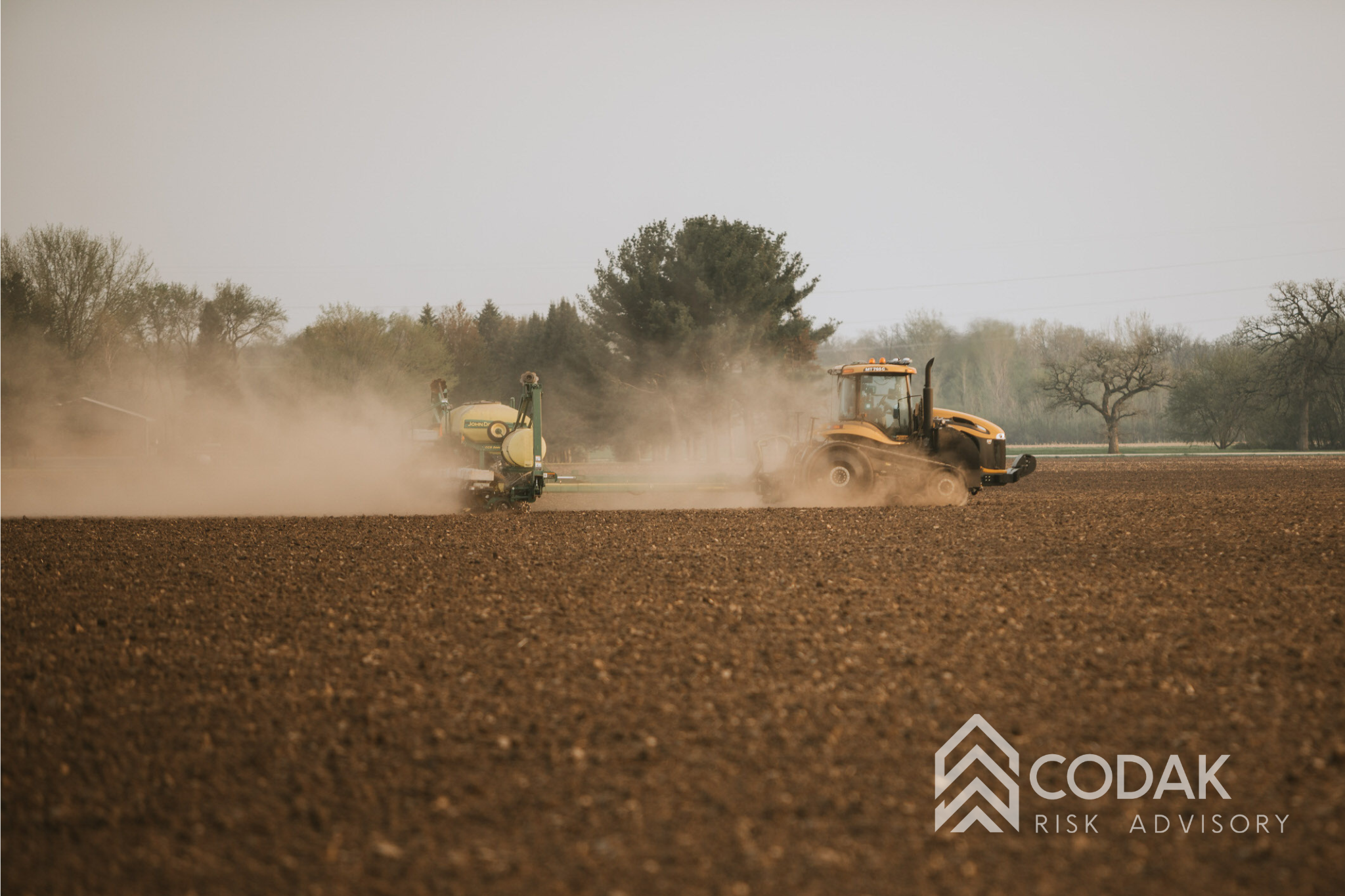
There’s no bullish supply story currently brewing in the markets from a planting perspective, even if you need to replant on your farm.
Planting progress is moving right along on schedule per NASS estimates, and that likely matches what many of us are seeing from the backroads. Now is the time to consider whether replanting is prudent. The real question is this: how much will the market worry about the crop, and how much should you worry about it yourself?
The Market's “WORRY”
When the market is “worried,” it is simply trying to create a price point that rations supply appropriately against demand. Prevented planted acres are more significant for market concerns because inserting a zero yield on those acres lowers the national average much faster than poor yields, obviously. As we don’t likely have any appreciable prevented planting occurring this year (knock on wood), we’ll shift focus to replanted acres.
Looking at RMA data from 2016 through 2025, replanted acreage has been fairly steady.
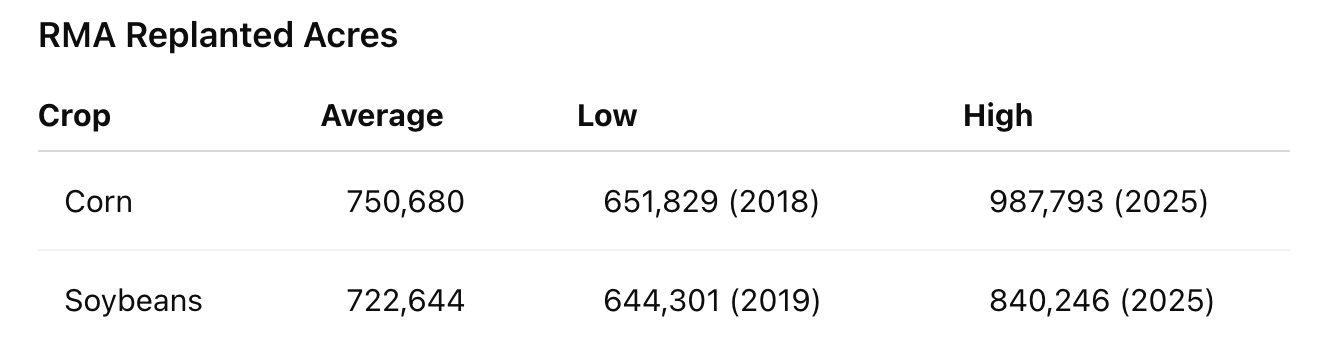
It makes sense that soybean replanting was lowest in 2019, given the historically late planting pace that year and the historically high level of prevented planting, which would have precluded the “opportunity” to replant soybeans. Last year’s replanting highs also make sense given the larger overall acreage for each crop.
Note that even in the worst years, we don’t replant more than 2% of the crop. We average under 1% of planted acreage. Given the low average rate, replanted acreage doesn’t seem to move the needle too much.
Granted, the later the planting, the more the market may notice, BUT even that is muted unless it’s really widespread. Why? Well, for one thing, we now have speed planters hitting fields at 7-10mph, while less than a generation ago, 5mph felt too fast for old finger-pickup meters! The market “knows” we can plant much faster than just a decade ago. And replanted stands can yield surprisingly well.
There really is not a supply-side story developing in the corn, soybean, or spring wheat markets right now, and the past 10 years of data help explain why.
Your Worry
Your farm, however, is a very different worry.
Replant, unfortunately, shifts the focus from maximizing profit to minimizing the loss. So, what does a replant mean for your farm?
For one, if you’re going to replant, it’s often in concentrated areas or perhaps entire fields—probably more than 1-2% of your acreage —so you have more at risk than the market would.
For another, your farm probably isn’t perfectly correlated with the market. That is, if you’re replanting, it’s unlikely that this is a statewide concern that would affect national final yields. If your farm is on the fringe—especially outside the “I” states—then replant is especially worse because your reduced yield expectations don’t drive the market nearly as much. In other words, your reduced yields may not affect the market enough to drive a rally.
Replanting is obviously never a fun prospect. The agronomy behind the decision depends on soil type, stand uniformity, and expected yield potential. Those factors make a hard-and-fast answer difficult. In fact, keeping a marginal stand is actually better than replanting too late to establish a good one, according to research. Still, a marginal stand is tough to swallow in any crop year, especially when margins are already tight.
University thresholds do offer insight.
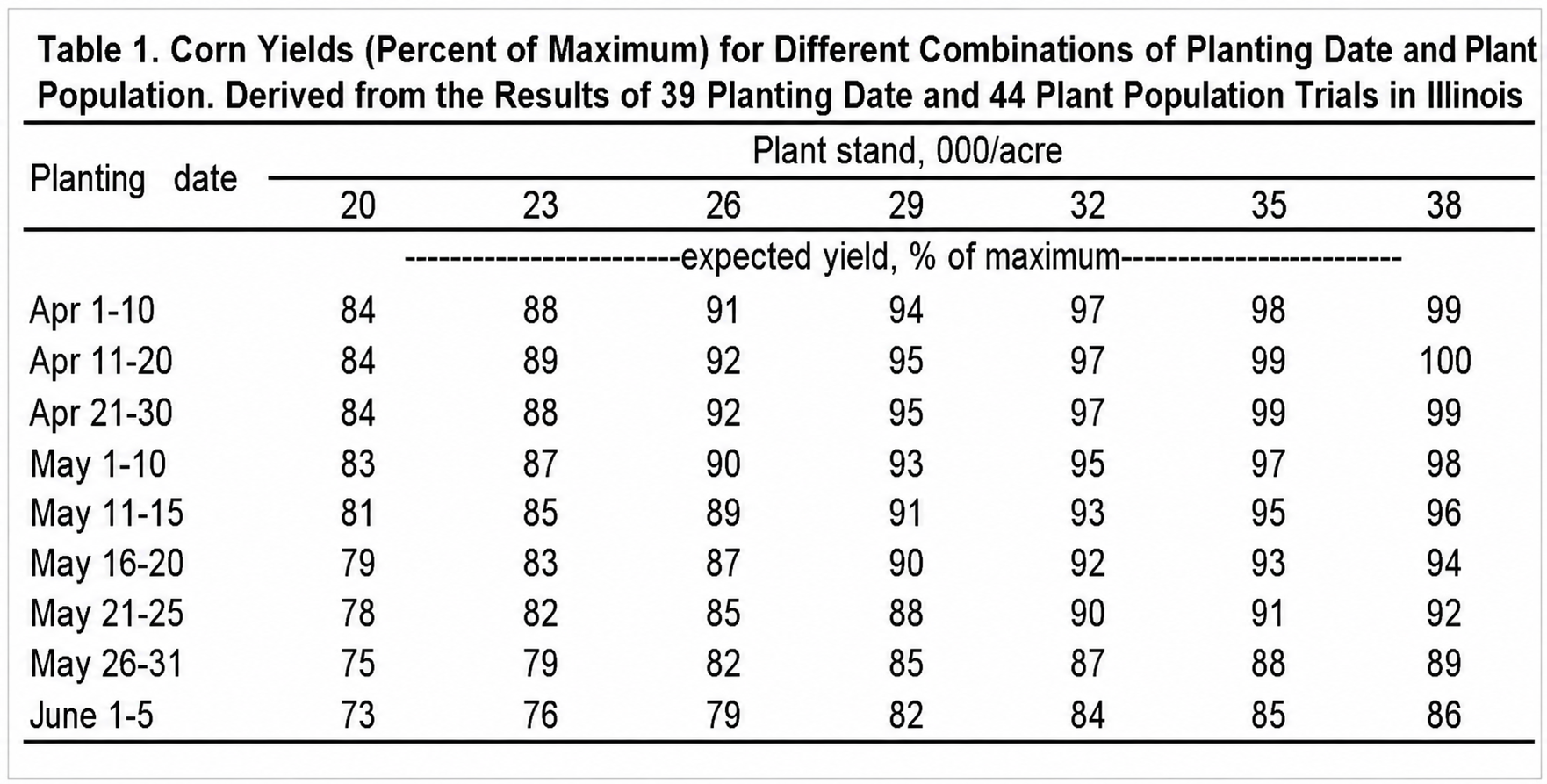
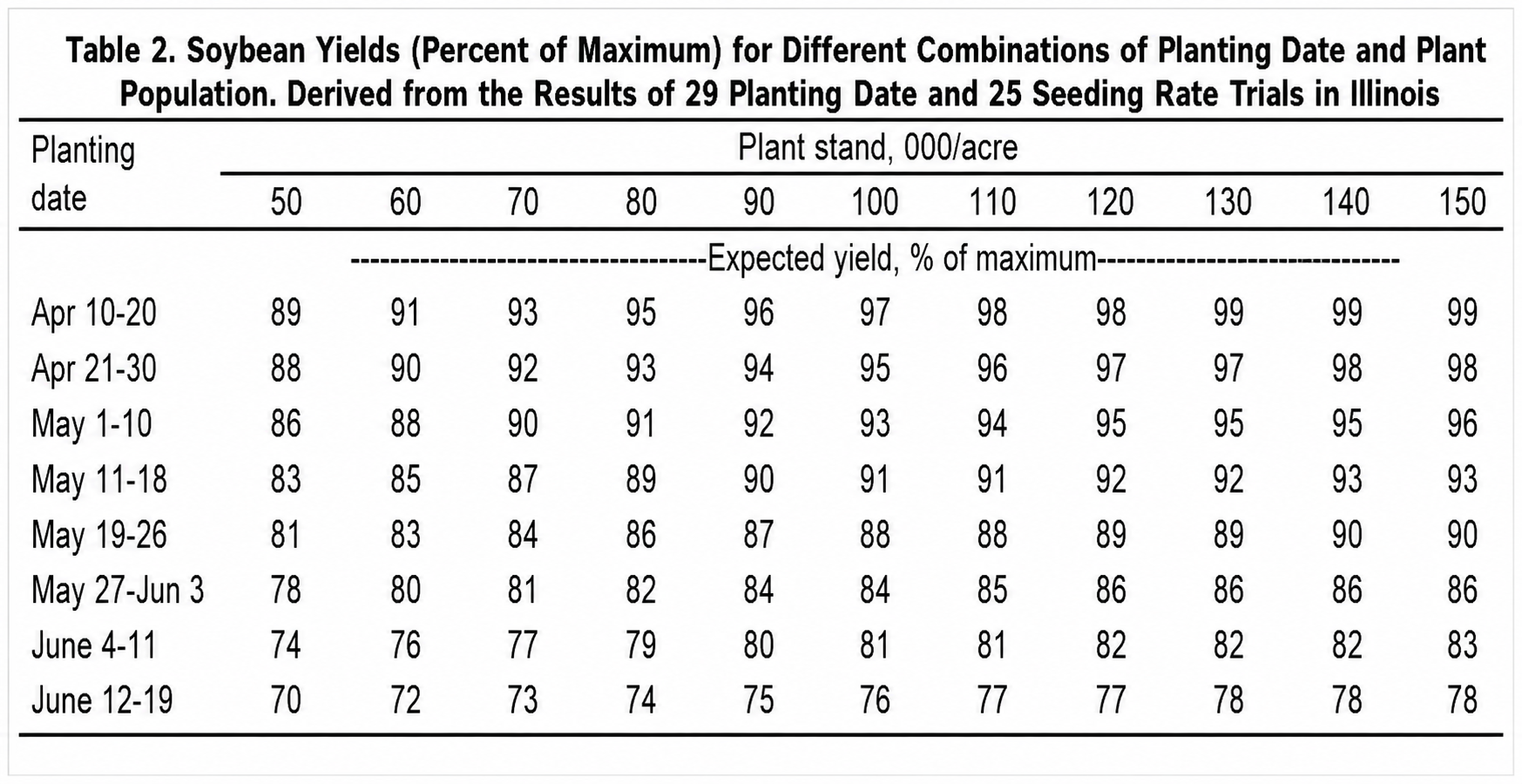
The University of Illinois offers charts to help assess what percentage of full yield may still be possible given the consistent plant stand and the planting date.
Corn and Soybean Yield Potential by Planting Date
So What?
If you need to replant, it is IMPERATIVE to do so correctly both agronomically AND procedurally.

From an agronomy standpoint, do not cut populations too aggressively or “mud” the crop in. You don’t want to replant a third time. Consider whether your current, sub-par stand planted early has more yield potential than a better stand planted later.
For procedure, don’t leave money on the table. Accept that the futures market isn’t as concerned about replant as you are. Don’t let replant and its associated emotions muddy the waters of your marketing plan. Moreover, your crop insurance comes into play here –
Replant notice + consent required: Producers must submit a replant notice and consult their adjuster before replanting. Replanting without prior consent may keep coverage in force, but no MPCI replant payment will be issued.
Second crop vs. replant: If replanting is deemed practical but the insured plants a different crop or chooses not to replant, the initial crop becomes uninsurable and no replant payment or indemnity will be paid. Planting a second crop requires adjuster consent to release acreage and an on-farm inspection.
Don’t leave money on the table. If you have crop insurance, your policy covers replant:

You MUST follow the procedure to qualify! Call your agent BEFORE you turn a tractor tire!
Bottom line, while you may need to worry about replant, the market does not. Focus on replanting to minimize losses and not lose sight of market opportunities even in the face of negative emotions during a second planting pass.
We at CODAK hope you have a safe and strong finish to planting and early-season fieldwork.

Andrew Bowman
General Manager - Insurance| Market Advisor, Central Midwest
A former client turned Market Advisor, Andrew, oversees Illinois and the surrounding region. He also leads the CODAK Insurance Group, integrating crop insurance into our clients’ marketing strategies. His focus is on helping clients make confident decisions, gain peace of mind, and protect their working capital.
Connect with Andrew