
Count Crops, Calibrate Hedges
How better yield estimates lead to better harvest, insurance, and marketing decisions
Harvest is still comfortably a month or more away for most of us, but harvest decisions are beginning now. The first question is simple: What is your yield going to be?
As of the first week of August, USDA pegged corn at 90% silked and 43% dough, while soybeans were 88% blooming and 62% setting pods. August weather will matter more for soybeans, but do not discount its impact on corn test weight. Market services and crop tours will soon publish their estimates—and debate how far USDA’s forecast may be off.
Before we argue about the national number, we should firm up our own.
Corn: The “Easier” Estimate
Corn is a determinant grass. Once it ends vegetative growth, it goes all-in on reproduction and kernel development. That means some stress is permanent—poor pollination or kernel abortion from July heat cannot be recovered—but it also makes corn yield easier to estimate.
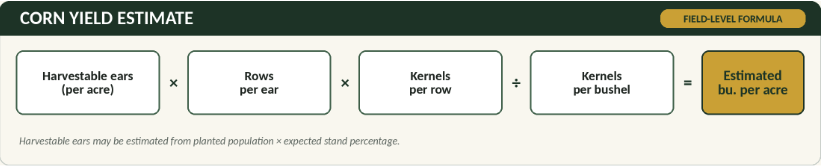
On one of my fields, we planted 36,700 seeds per acre, but my rough count was closer to 35,500 harvestable ears. The ears we pulled averaged 16 rows around and 38 kernels long. A normal assumption might be 80,000 kernels per bushel, but with a favorable August outlook in western Illinois, I used 75,000.

I am not banking 287 bpa. My APH is closer to 235, so that would require roughly a 22% yield gain in one year. It is possible, but 250 bpa feels more realistic after accounting for stress, field variation, test weight risk, and normal harvest loss. That is still about 5% better than my APH and roughly 90% of the raw estimate.
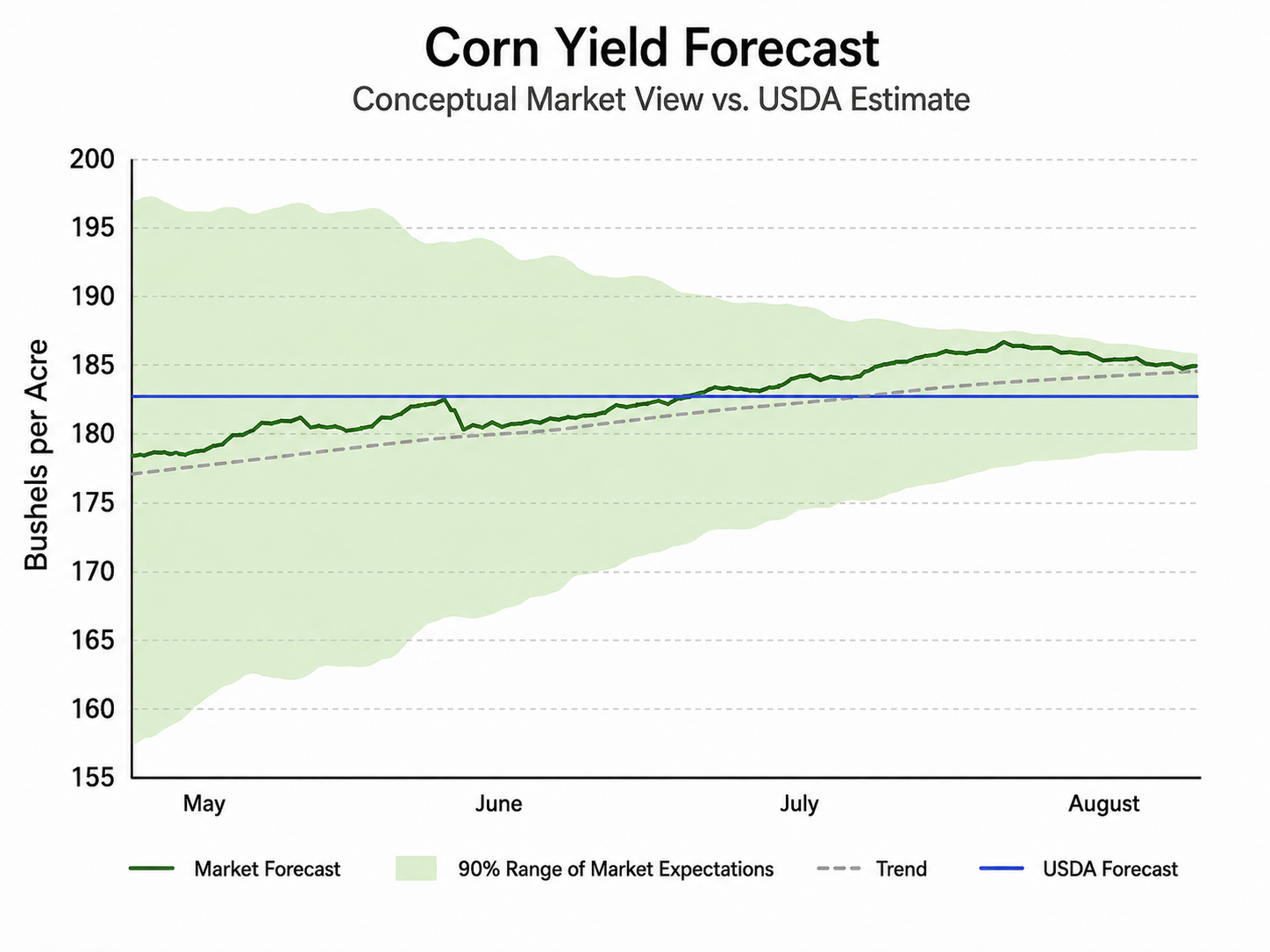
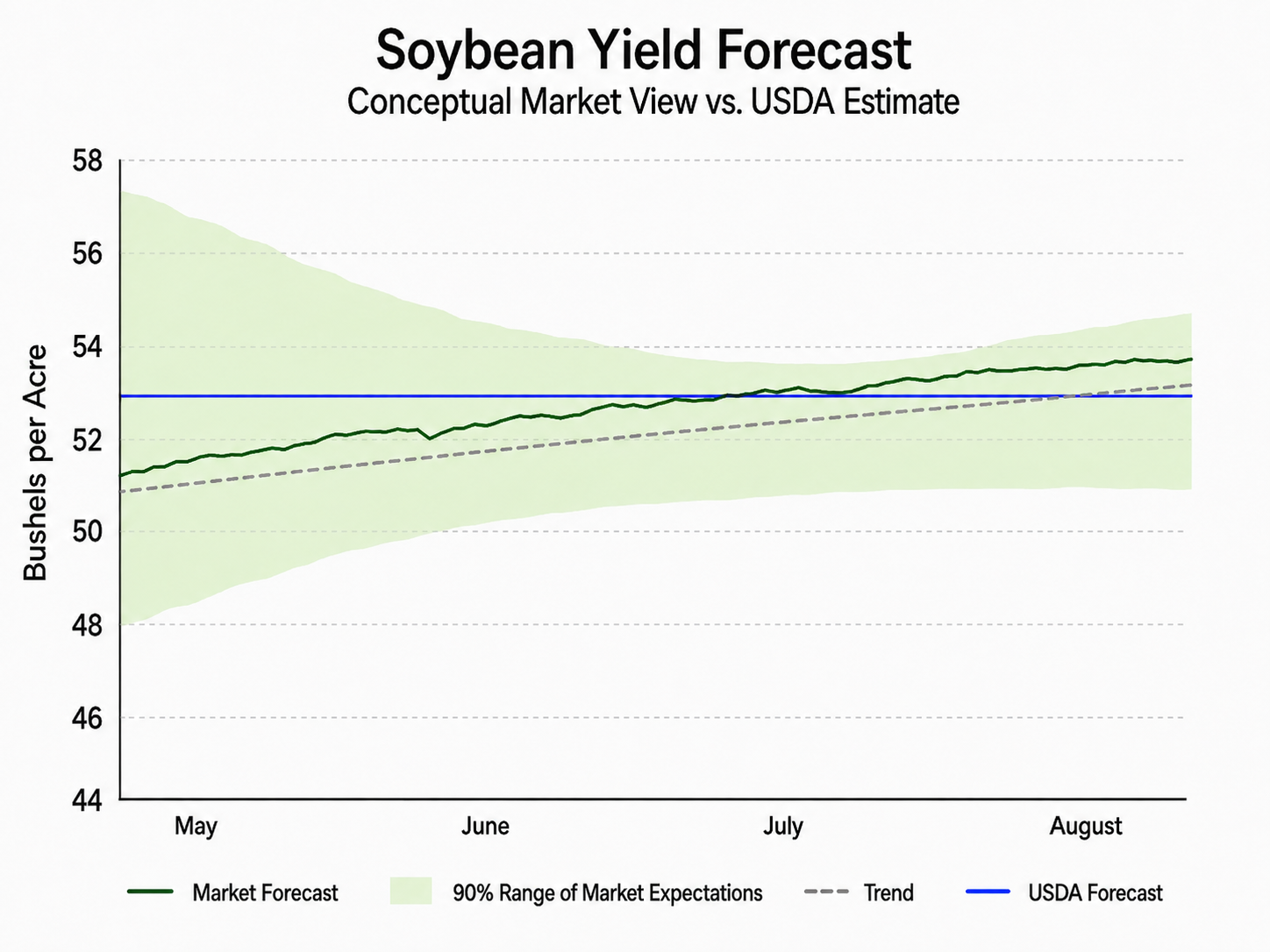
The point is not to produce a perfect number. It is to begin with the crop’s physical potential, then honestly discount it. As harvest approaches, our confidence range should narrow. A conceptual yield forecasting model shows the same process: the green confidence bands tighten as the season progresses.
Soybeans: More Art Than Science
Soybeans are trickier. Most U.S. soybeans are indeterminate, meaning they can grow vegetatively and reproductively at the same time. They compensate. My non-GMO beans prove it every year: they look nearly dead after a harsh herbicide application, then revive two weeks later. Unfortunately, after a wet June, the weeds can revive too.
A soybean estimate has more moving pieces. Plants carry many pods rather than one ear; pods may contain two, three, or four seeds; and seed size can vary dramatically. I have planted seeds as large as 2,600 seeds per pound and as small as 3,800.
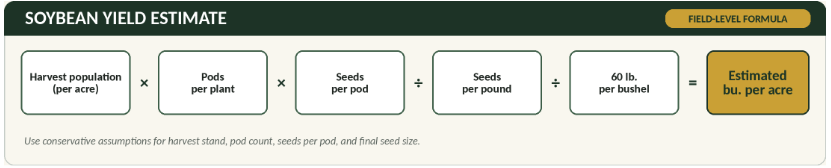
Here is a reasonable baseline from our farm. We planted 135,000 seeds per acre. Robot stand counts averaged 128,000, but I will use 115,000 to be conservative. I counted about 40 pods per plant, assumed 2.75 seeds per pod, and used 3,000 seeds per pound.

My soybean APH is 69, so 70 is believable. I think it will be too high in pockets where weeds won and too low where early rains created excellent branching. With another 1–3 inches of rain before Labor Day and nighttime temperatures below 70 degrees, even +80bpa is possible.
Harvest conditions can still change the result. Last year, hot temperatures and 20-plus mph winds caused flash drying, and many fields were harvested below 9% moisture. Against a 13% standard, that can cost several bushels per acre. Soybean estimates therefore need more humility—and wider ranges—than corn estimates. Our conceptual yield forecast reflects this wider uncertainty.
So What Do We Do With the Estimate?
First, plan harvest logistics.
A larger crop may require more storage, earlier trucking arrangements, or different bin allocations. A smaller crop may let you consolidate storage or change the order in which fields are harvested.
Second, update crop insurance and contract risk.
Your spring guarantee is anchored, but revenue-to-count changes with the fall price and actual yield. If a claim is possible, estimate it early and organize harvest records so payment is not delayed. If production may be insufficient to fill contracts, communicate with grain buyers now. Most contracts can be bought out, but processors may require physical bushels. Crop insurance can protect the financial loss, while your market advisor helps manage the logistics.
Third, consider county-level coverage and basis.
ECO and SCO are county products. Your own fields are not the county, but local yield checks help frame whether the county may outperform or underperform expectations. Regional yield differences also matter for basis. Areas with short crops must bid harder to source grain; areas with large crops can face storage pressure.
Finally, rebalance the marketing plan.
My 235-bpa corn APH is currently about 40% sold, or 94 bpa. If I accept a 250-bpa estimate, I am actually only 38% sold. I have more bushels to market. If the estimate falls to 220-bpa, I am 43% sold. Effective estimates may change whether I store, sell, write option premium, or adjust hedges.
A Best Estimate—and a Worst Case
Yield estimates are still estimates. We can make assumptions that confirm whatever we want to believe. The discipline is to be honest.
Make two estimates for each crop. The first should be your best, most likely estimate—the number you will use for logistics, insurance, and marketing decisions. The second should be a realistic worst-case estimate.
No one enjoys planning a poor crop, but uncertainty creates more anxiety than a defined downside.
We will not know the final yield until the combine is parked, and every bushel has crossed a scale. But a thoughtful estimate narrows the range around projected revenue.
That makes crop insurance, storage, contracts, and marketing decisions more straightforward—and gives us a better chance to optimize the crop we actually have.

Andrew Bowman
General Manager - Insurance| Market Advisor, Central Midwest
A former client turned Market Advisor, Andrew, oversees Illinois and the surrounding region. He also leads the CODAK Insurance Group, integrating crop insurance into our clients’ marketing strategies. His focus is on helping clients make confident decisions, gain peace of mind, and protect their working capital.
Connect with Andrew